Wednesday, December 31, 2014

5 Stocks Under $10 Set to Soar Higher

DELAFIELD, Wis. (Stockpickr) -- There isn't a day that goes by on Wall Street when certain stocks trading for $10 a share or less don't experience massive spikes higher. Traders savvy enough to follow the low-priced names and trade them with discipline and sound risk management are banking ridiculous coin on a regular basis.

Just take a look at some of the big movers in the under-$10 complex from Thursday, including Geron (GERN), which is exploding higher by 29%; Zalicus (ZLCS), which is ripping higher by 29%; Onconova Therapeutics (ONTX), which is soaring higher by 22%; and Arotech (ARTX), which is trending higher by 17%. You don't even have to catch the entire move in lower-priced stocks such as these to make outsized returns when trading.

One low-priced stock that's exploding higher today is biotechnology player Geron (GERN), which I highlighted in May 22's "5 Stocks Under $10 Set to Soar" at around $2 a share. I mentioned in that piece that shares of Geron were trending sideways and consolidating for the last two months, with the stock moving between $1.69 on the downside and $2.53 on the upside. This stock was just starting to spike higher off its 50-day moving average and move within range of triggering a major breakout trade above the upper end of its recent sideways trading chart pattern.

Guess what happened? Shares of Geron started to trigger that breakout on Wednesday after the stock ripped sharply higher and closed above $2.53 a share with heavy upside volume. Volume on Wednesday registered 13.5 million shares, which is well above its three month average action of 5.32 million shares. Shares of GERN are exploding higher again today with the stock trading up close to 30% at around $3.30 a share. That represents a monster gain of 70% from the time I first flagged this stock near $2 a share.

Low-priced stocks are something that I tweet about on a regular basis. I frequently flag high-probability setups, breakout candidates and low-priced stocks that are acting technically bullish. I like to hunt for low-priced stocks that are showing bullish price and volume trends, since that increases the probability of those stocks heading higher. These setups often produce monster moves higher in very short time frames.

When I trade under-$10 names, I do it almost entirely based off of the charts and technical analysis. I also like to find under-$10 names with a catalyst, but that's secondary to the chart and volume patterns.

With that in mind, here's a look at several under-$10 stocks that look poised to potentially trade higher from current levels.

Synthesis Energy Systems

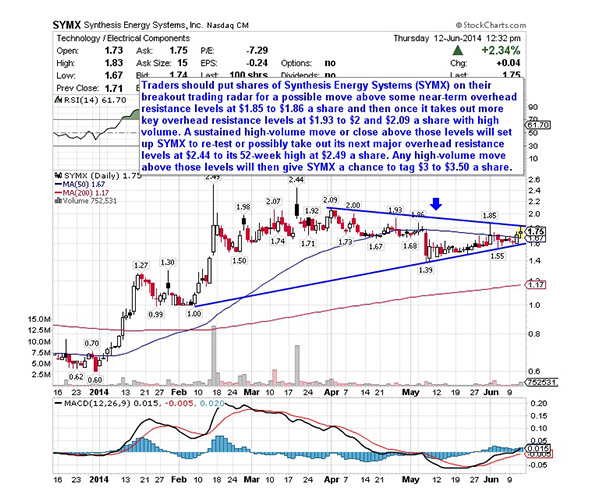
One under-$10 specialty chemicals player that's starting to move within range of triggering a major breakout trade is Synthesis Energy Systems (SYMX), which provides various proprietary gasification technology systems and solutions to the energy and chemical industries worldwide. This stock is off to a red hot start so far in 2014, with shares up a whopping 191%.

If you glance at the chart for Synthesis Energy Systems, you'll see that this stock has been uptrending over the last month and change, with shares moving higher from its low of $1.39 to its recent high of $1.85 a share. During that uptrend, shares of SYMX have been making mostly higher lows and higher highs, which is bullish technical price action. That move has started to push shares of SYMX within range of triggering a major breakout trade above some key near-term overhead resistance levels.

Traders should now look for long-biased trades in SYMX if it manages to break out above some near-term overhead resistance levels at $1.85 to $1.86 a share and then once it takes out more key overhead resistance levels at $1.93 to $2 and $2.09 a share with high volume. Look for a sustained move or close above those levels with volume that hits near or above its three-month average action of 594,782 shares. If that breakout gets underway soon, then SYMX will set up to re-test or possibly take out its next major overhead resistance levels at $2.44 to its 52-week high at $2.49 a share. Any high-volume move above those levels will then give SYMX a chance to tag $3 to $3.50 a share.

Traders can look to buy SYMX off weakness to anticipate that breakout and simply use a stop that sits right below some key near-term support levels at $1.60 to $1.55 a share. One can also buy SYMX off strength once it starts to clear those breakout levels with volume and then simply use a stop that sits a comfortable percentage from your entry point.

Endocyte

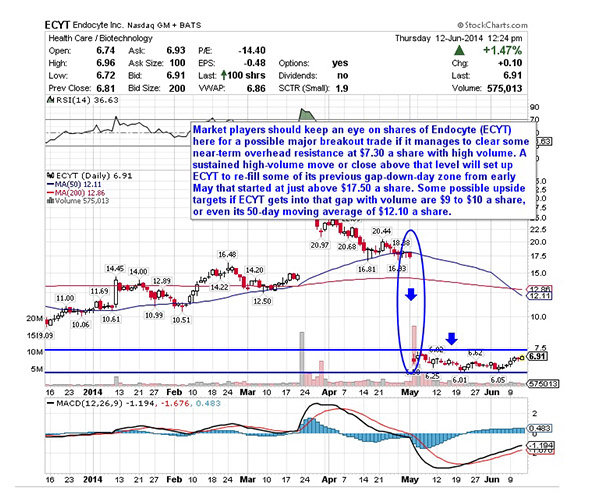
An under-$10 biopharmaceutical player that's starting to trend within range of triggering a big breakout trade is Endocyte (ECYT), which develops targeted therapies for the treatment of cancer and inflammatory diseases in the U.S. This stock is off to a nasty start in 2014, with shares down sharply by 35%.

If you take a look at the chart for Endocyte, you'll see that this stock has been trending sideways and consolidating for the last month and change, with shares moving between $6.01 on the downside and right around $7.30 on the upside. This consolidation pattern is coming after shares of ECYT gapped down sharply in May from over $17.50 to $6.50 a share with heavy downside volume. Shares of ECYT are now starting to trend higher off its recent low of $6.05 and it's quickly moving within range of triggering a major breakout trade above the upper-end of its recent sideways trading chart pattern.

Market players should now look for long-biased trades in ECYT if it manages to break out above some near-term overhead resistance at $7.30 a share with high volume. Look for a sustained move or close above that level with volume that registers near or above its three-month average action of 1.90 million shares. If that breakout materializes soon, then ECYT will set up to re-fill some of its previous gap-down-day zone from early May that started at just above $17.50 a share. Some possible upside targets if ECYT gets into that gap with volume are $9 to $10 a share, or even its 50-day moving average of $12.10 a share.

Traders can look to buy ECYT off weakness to anticipate that breakout and simply use a stop that sits right below its recent 52-week low of $6.01 a share. One can also buy ECYT off strength once it starts to take out $7.30 a share with volume and then simply use a stop that sits a comfortable percentage from your entry point.

BG Medicine​

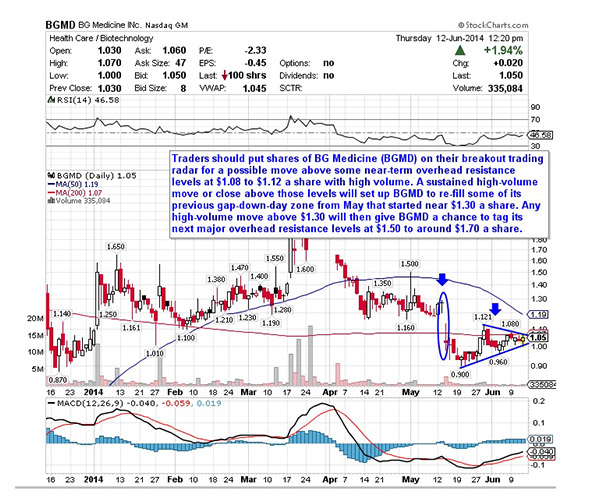
Another stock that's starting to move within range of triggering a big breakout trade is BG Medicine (BGMD), which develops and commercializes novel cardiovascular diagnostic tests to address unmet medical needs in the U.S. This stock has been pushed lower by the sellers over the last three months, with shares down sharply by 20%.

If you take a glance at the chart for BG Medicine, you'll notice that this stock has been uptrending a bit for the last month, with shares moving higher from its low of 90 cents per share to its recent high of $1.12 a share. During that uptrend, shares of BGMD have been making mostly higher lows and higher highs, which is bullish technical price action. That move has now pushed shares of BGMD within range of triggering a big breakout trade above some key near-term overhead resistance levels.

Traders should now look for long-biased trades in BGMD if it manages to break out above some near-term overhead resistance levels at $1.08 to $1.12 a share with high volume. Look for a sustained move or close above those levels with volume that hits near or above its three-month average action of 1.56 million shares. If that breakout gets started soon, then BGMD will set up to re-fill some of its previous gap-down-day zone from May that started near $1.30 a share. Any high-volume move above $1.30 will then give BGMD a chance to tag its next major overhead resistance levels at $1.50 to around $1.70 a share.

Traders can look to buy BGMD off weakness to anticipate that breakout and simply use a stop that sits right below some key near-term support levels at 96 cents to 90 cents per share. One can also buy BGMD off strength once it starts to clear those breakout levels with volume and then simply use a stop that sits a comfortable percentage from your entry point.

Exelixis​

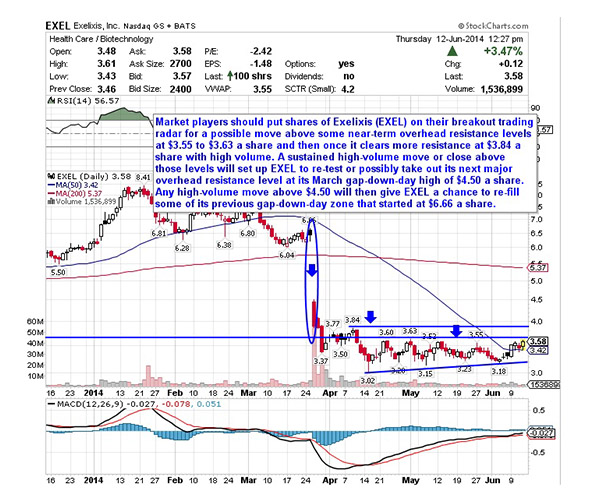
Another under-$10 biotechnology player that's starting to trend within range of triggering a near-term breakout trade is Exelixis (EXEL), which develops small molecule therapies for the treatment of cancer in the U.S. This stock has been crushed by the bears so far in 2014, with shares down sharply by 41%.

If you look at the chart for Exelixis, you'll notice that EXEL has been trending sideways and consolidating for the last two months and change, with shares moving between $3.02 on the downside and $3.84 on the upside. Shares of EXEL are starting to spike higher today right off its 50-day moving average of $3.42 a share. That spike is quickly pushing shares of EXEL within range of triggering a near-term breakout trade above some key overhead resistance levels.

Market players should now look for long-biased trades in EXEL if it manages to break out above some near-term overhead resistance levels at $3.55 to $3.63 a share and then once it clears more resistance at $3.84 a share with high volume. Look for a sustained move or close above those levels with volume that hits near or above its three-month average action of 4.85 million shares. If that breakout kicks off soon, then EXEL will set up to re-test or possibly take out its next major overhead resistance level at its March gap-down-day high of $4.50 a share. Any high-volume move above $4.50 will then give EXEL a chance to re-fill some of its previous gap-down-day zone that started at $6.66 a share.

Traders can look to buy EXEL off weakness to anticipate that breakout and simply use a stop that sits right below some key near-term support levels at $3.18 to $3.02 a share. One can also buy EXEL off strength once it starts to move above those breakout levels with volume and then simply use a stop that sits a comfortable percentage from your entry point.

Northwest Biotherapeitics

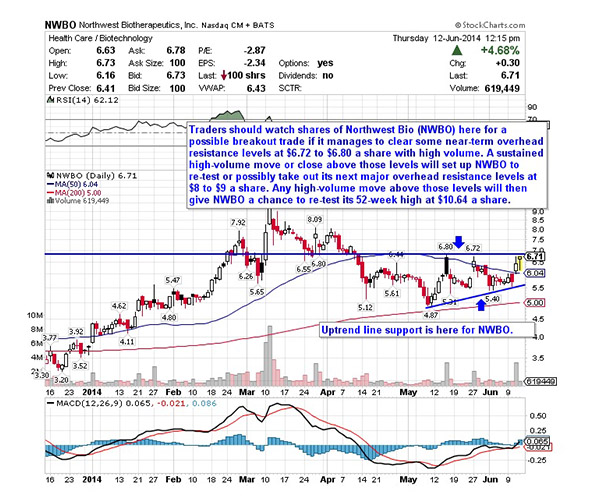
One final under-$10 biopharmaceuticals player that looks ready to trigger a near-term breakout trade is Northwest Biotherapeitics (NWBO), which discovers and develops immunotherapy products to treat cancers in the U.S. and internationally. This stock has been off to a monster start so far in 2014, with shares up sharply by 78%.

If you take a glance at the chart for Northwest Biotherapeutics, you'll notice that this stock has been uptrending for the last month, with shares moving higher from its low of $4.87 to its recent high of $6.80 a share. During that uptrend, shares of NWBO have been making mostly higher lows and higher highs, which is bullish technical price action. That uptrend started right off NWBO's 200-day moving average and the stock has now started to spike higher today right off its 50-day moving average. This move is starting to push shares of NWBO within range of triggering a near-term breakout trade above some key overhead resistance levels.

Traders should now look for long-biased trades in NWBO if it manages to break out above some near-term overhead resistance levels at $6.72 to $6.80 a share with high volume. Look for a sustained move or close above those levels with volume that hits near or above its three-month average action of 991,491 shares. If that breakout triggers soon, then NWBO will set up re-test or possibly take out its next major overhead resistance levels at $8 to $9 a share. Any high-volume move above those levels will then give NWBO a chance to re-test its 52-week high at $10.64 a share.

Traders can look to buy NWBO off weakness to anticipate that breakout and simply use a stop that sits right below its 50-day moving average of $6.04 a share or around more support at $5.50 a share. One can also buy NWBO off strength once it starts to trade above those breakout levels with volume and then simply use a stop that sits a comfortable percentage from your entry point.

To see more hot under-$10 equities, check out the Stocks Under $10 Setting Up to Explode portfolio on Stockpickr.

-- Written by Roberto Pedone in Delafield, Wis.


RELATED LINKS:


>>3 Huge Stocks Everyone Is Talking About >>5 Health Care Stocks to Trade for Gains in June >>4 Stocks Breaking Out on Big Volume


Follow Stockpickr on Twitter and become a fan on Facebook.

At the time of publication, author had no positions in stocks mentioned.

Roberto Pedone, based out of Delafield, Wis., is an independent trader who focuses on technical analysis for small- and large-cap stocks, options, futures, commodities and currencies. Roberto studied international business at the Milwaukee School of Engineering, and he spent a year overseas studying business in Lubeck, Germany. His work has appeared on financial outlets including CNBC.com and Forbes.com. You can follow Pedone on Twitter at www.twitter.com/zerosum24 or @zerosum24.


Tuesday, December 30, 2014

Top Valued Stocks To Watch Right Now

We are always on the lookout for small- and mid-cap dividend payers, and we view a history of dividend growth as a favorable indicator, explains Richard Moroney; here, he highlights three stocks on the buy list of Upside, which offer dividend-growth prospects.

Aceto (ACET) announced a 9% increase in its per-share dividend in August, the first increase since it switched to a quarterly payout schedule in 2012.

At $0.24 per share, the new annual dividend represents less than 26% of trailing 12-month earnings, so continued dividend growth is likely if Aceto can maintain its operating momentum.

For the September quarter, the maker of pharmaceutical and chemical products reported a 122% increase in per-share earnings on nearly 16% growth in sales. Aceto, reasonably valued at less than 17 times the two-analyst consensus profit estimate of $1.20 per share for the year ending June, is a Best Buy. The stock yields 1.2%.

When HanesBrands (HBI) initiated a quarterly dividend in April, the underwear maker said the move reflected its debt-reduction progress, cash-flow growth, and margin-improvement prospects.

Hot Small Cap Stocks To Watch Right Now: Caterpillar Inc.(CAT)

Caterpillar Inc. manufactures and sells construction and mining equipment, diesel and natural gas engines, industrial gas turbines, and diesel-electric locomotives worldwide. It operates through three lines of businesses: Machinery, Engines, and Financial Products. The Machinery business offers construction, mining, and forestry machinery, including track and wheel tractors, track and wheel loaders, pipelayers, motor graders, wheel tractor-scrapers, track and wheel excavators, backhoe loaders, log skidders, log loaders, off-highway trucks, articulated trucks, paving products, skid steer loaders, underground mining equipment, tunnel boring equipment, and related parts. It also manufactures diesel-electric locomotives; and manufactures and services rail-related products and logistics services for other companies. The Engines business provides diesel, heavy fuel, and natural gas reciprocating engines for Caterpillar machinery, electric power generation systems, marine, petrol eum, construction, industrial, agricultural, and other applications. It offers industrial turbines and turbine-related services for oil and gas, and power generation applications. This business also remanufactures Caterpillar engines, machines, and engine components; and offers remanufacturing services for other companies. The Financial Products business provides retail and wholesale financing alternatives for Caterpillar machinery and engines, solar gas turbines, and other equipment and marine vessels, as well as offers loans and various forms of insurance to customers and dealers. It also offers financing for vehicles, power generation facilities, and marine vessels. The company markets its products directly, as well as through its distribution centers, dealers, and distributors. It was formerly known as Caterpillar Tractor Co. and changed its name to Caterpillar Inc. in 1986. Caterpillar Inc. was founded in 1925 and is headquartered in Peoria, Illinois.

Advisors' Opinion:
  • [By Dan Caplinger]

    Finally, the U.S. dollar finished weaker against the euro and the British pound but strengthened against the Japanese yen. During this earnings season, we've seen many companies struggle due to the impact of the strong dollar on the value of their foreign revenue and earnings. For instance, Caterpillar (NYSE: CAT  ) cited what it called a "substantial currency headwind" in its second quarter that weighed on its disappointing results. The company doesn't expect a recurrence of the $134 million in currency-translation and hedging losses it suffered during the quarter, but investors should keep an eye on currency movements and weigh their potential impact on earnings.

  • [By John Divine]

    Caterpillar (NYSE: CAT  ) stock refused to lose -- as it had in the previous four trading sessions -- and added 1.2% after announcing a $1 billion share buyback plan. The shares in particular will be bought back from a French bank. With a market cap around $54 billion, the repurchase agreement will materially reduce the number of shares outstanding, spreading the company's earnings among a smaller pool of shareholders. Caterpillar seems to think its stock is pretty cheap right now. It also bought back $1 billion of its stock in June.�

  • [By Travis Hoium]

    Caterpillar (NYSE: CAT  ) is taking the biggest hit on the Dow, crashing 3.1% today. The company relies on growth in emerging markets to grow sales, and China's GDP numbers will always affect the stock in the short term. A lot of this weakness is already priced into the stock, so it may not be bad for long-term investors. The company reports earnings next Monday, and estimates call for $1.44 per share in earnings, down from $2.37 a year ago.

  • [By GuruFocus] l Gates added to his holdings in Caterpillar Inc by 4.65%. His purchase prices were between $82.12 and $91.15, with an estimated average price of $85.32. The impact to his portfolio due to this purchase was 0.23%. His holdings were 11,260,857 shares as of 12/31/2013.

    Added: Wal-Mart Stores Inc (WMT)

    Bill Gates added to his holdings in Wal-Mart Stores Inc by 4.5%. His purchase prices were between $71.87 and $81.21, with an estimated average price of $77.52. The impact to his portfolio due to this purchase was 0.2%. His holdings were 11,603,000 shares as of 12/31/2013.

    Sold Out: Procter & Gamble Co (PG)

    Bill Gates sold out his holdings in Procter & Gamble Co. His sale prices were between $75.65 and $85.41, with an estimated average price of $81.56.

    Sold Out: Air Products & Chemicals Inc (APD)

    Bill Gates sold out his holdings in Air Products & Chemicals Inc. His sale prices were between $102.58 and $113.66, with an estimated average price of $108.95.

    Sold Out: Toyota Motor Corp (TM)

    Bill Gates sold out his holdings in Toyota Motor Corp. His sale prices were between $118.61 and $131.65, with an estimated average price of $125.74.

    Sold Out: Diamond Foods, Inc. (DMND)

    Bill Gates sold out his holdings in Diamond Foods, Inc.. His sale prices were between $20.78 and $26.05, with an estimated average price of $23.92.

    Here is the complete portfolio of Bill Gates.�


    Also check out: Bill Gates Undervalued Stocks Bill Gates Top Growth Companies Bill Gates High Yield stocks, and Stocks that Bill Gates keeps buying

    Currently 0.00/512345

    Rating: 0.0/5 (0 votes)

    Subscribe via Email Subscribe RSS

Top Valued Stocks To Watch Right Now: Schlumberger N.V.(SLB)

Schlumberger Limited, together with its subsidiaries, supplies technology, integrated project management, and information solutions to the oil and gas exploration and production industries worldwide. The company?s Oilfield Services segment provides exploration and production services; wireline technology that offers open-hole and cased-hole services; supplies engineering support, directional-drilling, measurement-while-drilling, and logging-while-drilling services; and testing services. This segment also offers well services; supplies well completion services and equipment; artificial lift; data and consulting services; geo services; and information solutions, such as consulting, software, information management system, and IT infrastructure services that support oil and gas industry. Its WesternGeco segment provides reservoir imaging, monitoring, and development services; and operates data processing centers and multiclient seismic library. This segment also offers variou s services include 3D and time-lapse (4D) seismic surveys to multi-component surveys for delineating prospects and reservoir management. The company?s M-I SWACO segment supplies drilling fluid systems to improve drilling performance; fluid systems and specialty tools to optimize wellbore productivity; production technology solutions to maximize production rates; and environmental solutions that manages waste volumes generated in drilling and production operations. Its Smith Oilfield segment designs, manufactures, and markets drill bits and borehole enlargement tools; and supplies drilling tools and services, tubular, completion services, and other related downhole solutions. The company?s Distribution segment markets pipes, valves, and fittings, as well as mill, safety, and other maintenance products. This segment also provides warehouse management, vendor integration, and inventory management services. Schlumberger Limited was founded in 1927 and is based in Houston, Texas.

Advisors' Opinion:
  • [By Aaron Levitt]

    With a variety of oil stocks reporting full-year 2013 earnings, unconventional assets are the gifts that keep on giving for the oil service trio of Halliburton (HAL), Baker Hughes (BHI) and Schlumberger (SLB).

  • [By Aaron Levitt]

    With fracking and advanced drilling techniques becoming the norm — both onshore and off — the firms that do all of that heavy lifting are set to win big over the longer term. And there are none bigger than Halliburton (HAL) and Schlumberger (SLB). Both remain the undisputed kingpins of fracking and oil services.

Top Valued Stocks To Watch Right Now: Tupperware Corporation(TUP)

Tupperware Brands Corporation operates as a direct seller of various products across a range of brands and categories through an independent sales force. The company engages in the manufacture and sale of kitchen and home products, and beauty and personal care products. It offers preparation, storage, and serving solutions for the kitchen and home, as well as kitchen cookware and tools, children?s educational toys, microwave products, and gifts under the Tupperware brand name primarily in Europe, Africa, the Middle East, the Asia Pacific, and North America. The company provides beauty and personal care products, which include skin care products, cosmetics, bath and body care, toiletries, fragrances, nutritional products, apparel, and related products principally in Mexico, South Africa, the Philippines, Australia, and Uruguay. It offers beauty and personal care products under the Armand Dupree, Avroy Shlain, BeautiControl, Fuller, NaturCare, Nutrimetics, Nuvo, and Swissgar de brand names. The company sells its Tupperware products directly to distributors, directors, managers, and dealers; and beauty products primarily through consultants and directors. As of December 26, 2009, the Tupperware distribution system had approximately 1,800 distributors, 61,300 managers, and 1.3 million dealers; and the sales force representing the Beauty businesses approximately 1.1 million. The company was formerly known as Tupperware Corporation and changed its name to Tupperware Brands Corporation in December 2005. The company was founded in 1996 and is headquartered in Orlando, Florida.

Advisors' Opinion:
  • [By John Udovich]

    Everyone is familiar with�the Tupperware brand from�consumer products stock Tupperware Brands Corporation (NYSE: TUP) and you are probably familiar with the brands�of mid cap stock Jarden Corp (NYSE: JAH) along with small cap stocks Libbey Inc (NYSEMKT: LBY) and Lifetime Brands Inc (NASDAQ: LCUT); but what about the stocks themselves? Chances are, their brands or products are right under your nose at home and you probably don�� know anything about the mid cap or small cap stock behind them.

  • [By Arie Goren]

    After running this screen on May 21, 2013, before the markets' open, I discovered the following eight stocks: Sunoco Logistics Partners LP (SXL), Leggett & Platt Inc (LEG), Copa Holdings SA (CPA), RPC Inc. (RES), Tupperware Brands Corp. (TUP), Herbalife Ltd. (HLF), John Wiley & Sons Inc. (JW.A) and C.H. Robinson Worldwide Inc. (CHRW).

  • [By Jonathan Berr]

    Multilevel marketing (MLM) groups such as Herbalife operate through independent sales representatives, who earn money both through the sales of product and by recruiting other people to join their team. This business model — which is used by scores of companies, including�Pampered Chef, which is owned by Warren Buffett’s Berkshire Hathaway (BRK.B), Tupperware (TUP) and Mary Kay Cosmetics — is legal provided that actual products are sold.

  • [By Johanna Bennett]

    Corporate earnings took a back seat today to the Fed�� latest policy decision. Still, quarterly financial results, and other news sent shares of McCormick & Co. (MKC) and Tupperware (TUP), falling during regular market hours�Here�� a rundown of several of today�� moves:

Top Valued Stocks To Watch Right Now: Dollar Tree Inc.(DLTR)

Dollar Tree, Inc. operates discount variety stores in the United States and Canada. Its stores offer merchandise primarily at the fixed price of $1.00. The company operates its stores under the names of Dollar Tree, Deal$, Dollar Tree Deal$, Dollar Giant, and Dollar Bills. Its stores offer consumable merchandise, including candy and food, and health and beauty care, as well as household consumables, such as paper, plastics, household chemicals, in select stores, and frozen and refrigerated food; variety merchandise, which includes toys, durable housewares, gifts, party goods, greeting cards, softlines, and other items; and seasonal goods, such as Easter, Halloween, and Christmas merchandise. As of April 30, 2011, it operated 4,089 stores in 48 states and the District of Columbia, as well as 88 stores in Canada. The company was founded in 1986 and is based in Chesapeake, Virginia.

Advisors' Opinion:
  • [By Ted Cooper]

    Family Dollar (NYSE: FDO  ) reported sales growth even as earnings per share fell amid a tough operating environment and ongoing merger preparations. The company expects to close on a takeover offer proposed by Dollar Tree (NASDAQ: DLTR  ) within the next few quarters. The merger-related restructuring charges and fees hurt the company's bottom line, but earnings fell even after adding back those expenses. Here's what it could mean for shareholders.

Monday, December 29, 2014

Top 10 Managed Healthcare Stocks For 2014

NEW YORK (TheStreet) -- InterOil (IOC) fell sharply on Friday after shares resumed trading following its announcement it would sell a 61.3% stake in its Papua New Guinean natural-gas fields to Total SA  (TOT).

Total's acquisition, worth as much as $3.6 billion, will address development and expansion of the Elk-Antelope site's reserves with payment pending appraisal drilling and certification. The French oiler will pay $613 million upfront. Additional payments will be made upon completion of its appraisal and whether its estimates of between 5.4 trillion and 9 trillion cubic feet of gas can be farmed.

Investors fled the stock en masse triggering a waterfall of selling once trading resumed in the afternoon. The accepted cause was that a maximum $3.6 billion valuation was seen as too little for the undeveloped Elk-Antelope site, believed to potentially hold the largest natural-gas depository in Asia. Until a full valuation can be determined by 2016, investors who stick with the stock will stomach more than a year's uncertainty over exactly how much InterOil will benefit. 

Top 5 Performing Companies To Buy For 2015: Invacare Corporation (IVC)

Invacare Corporation designs, manufactures, and distributes medical equipment and supplies for non-acute care environment, including the home health care, retail, and extended care markets worldwide. The company offers mobility and seating products, including power wheelchairs, custom manual wheelchairs, personal mobility products, and seating and positioning products; lifestyle products, such as manual wheelchairs, personal care products, homecare beds, pressure relieving mattresses, and patient transport products; and respiratory therapy products comprising non-delivery oxygen, stationary oxygen concentrators, and aerosol products and oxygen accessories. It also provides assistance in the collection of outstanding co-pays, rental capabilities, software, and technology to streamline efficiencies, repair services, and replacement parts. In addition, the company distributes medical supplies, including ostomy, incontinence, diabetic, enteral, wound care, and urology products , as well as home medical equipment, including lifestyle products. Further, it manufactures and markets healthcare furnishings comprising beds, case goods, and patient handling equipment for the long-term care markets; specialty clinical recliners for dialysis and oncology clinics; and other home medical equipment and accessory products. Additionally, the company offers home medical equipment for rent. It serves home health care and medical equipment providers, distributors, and government locations through its sales force, telesales associates, and various organizations of independent manufacturers� representatives and distributors. Invacare Corporation was founded in 1885 and is headquartered in Elyria, Ohio.

Advisors' Opinion:
  • [By Roberto Pedone]

    Invacare (IVC) designs, manufactures and distributes a line of health care products for the non-acute care environment, including the home health care, retail and extended care markets. This stock closed up 2.3% at $16.73 in Monday's trading session.

    Monday's Volume: 218,000

    Three-Month Average Volume: 143,188

    Volume % Change: 75%

    From a technical perspective, IVC jumped higher here right above some near-term support at $16 with above-average volume. This move briefly pushed shares of IVC into breakout territory, since the stock flirted with some past resistance at $16.81. This move is also close to pushing shares of IVC above the upper-end of its recent sideways trading price action, that has seen IVC trade between $14.92 on the downside and $16.81 on the upside.

    Traders should now look for long-biased trades in IVC as long as it's trending above its 50-day at $15.75 and then once it sustains a move or close above Monday's high of $16.84 with volume that's near or above 143,188 shares. If we get that move soon, then IVC will set up to re-test or possibly take out its next major overhead resistance levels at $18.24 to $19.15.

Top 10 Managed Healthcare Stocks For 2014: Nektar Therapeutics(NKTR)

Nektar Therapeutics, a clinical-stage biopharmaceutical company, engages in developing a pipeline of drug candidates that utilize its PEGylation and polymer conjugate technology platforms. The company?s product pipeline consists of drug candidates across various therapeutic areas, including oncology, pain, anti-infectives, anti-viral, and immunology. Its research and development activities involve small molecule drugs, peptides, and other potential biologic drug candidates. The company?s proprietary drug candidates in clinical development comprise NKTR-118, a peripheral opioid antagonist, which has completed Phase II clinical trail for the treatment of opioid-induced constipation; BAY41-6551 that has completed Phase II clinical trail to treat gram-negative pneumonias; NKTR-102, a topoisomerase I inhibitor-polymer conjugate, which is in Phase II clinical trail for multiple cancer indications, including breast, ovarian, and colorectal; and NKTR-105 that is in Phase I clinica l trail to treat solid tumors. Its preclinical products consists of NKTR-119 (Opioid/NKTR-118 combinations) for the treatment of pain; NKTR-181 (abuse deterrent, tamper-resistant opioid) to treat pain; NKTR-194 (non-scheduled opioid) for the treatment of mild to moderate pain; NKTR-171 (tricyclic antidepressant) to treat neuropathic pain; and NKTR-140 (protease inhibitor candidate) to treat HIV. The company has collaboration with Bayer Healthcare LLC to develop BAY41-6551 (NKTR-061, Amikacin Inhale), which is an inhaled solution of amikacin, an aminoglycoside antibiotic; and a license agreement with AstraZeneca AB for the development and commercialization of Oral NKTR-118 and NKTR-119. In addition, Nektar Therapeutics has various license, manufacturing, and supply agreements for its technology with biotechnology and pharmaceutical companies, such as Affymax, Amgen, Baxter, Roche, Merck, Pfizer, and UCB Pharma. The company was founded in 1990 and is headquartered in San Franc isco, California.

Advisors' Opinion:
  • [By Jay Silverman]

    Steve Halpern: Another stock you follow closely is Nektar (NKTR). What do you see happening there?

    Jay Silverman: Yes, Nektar is another platform company at the MTSL and they are about to release data on one of their compounds that is a pain reliever-unlike the very severe side effects of OxyContin, the opioid pain relievers that are out there, which have caused severe health and addictive concerns, leading to very, very troublesome side effects and death in some cases.

  • [By Sean Williams]

    Nektar Therapeutics (NASDAQ: NKTR  ) delivered a double-digit gain for shareholders this week after reporting positive top-line data for NKTR-181, its oral chronic pain-treatment drug. NKTR-181 is an opioid-based compound that's designed to enter the brain slower than traditional opiates like oxycodone without sacrificing effectiveness and ultimately reducing addiction-like qualities to the medication. In trials, the data demonstrated that NKTR-181 had a statistically significant lower "drug liking" and "feeling high" score than oxycodone. While I'd certainly exercise caution in getting too excited, as the Food and Drug Administration is very harsh with regard to its regulation of opioid-based drugs, it's nonetheless good news for Nektar.

Top 10 Managed Healthcare Stocks For 2014: BankFinancial Corporation(BFIN)

BankFinancial Corporation operates as the holding company for BankFinancial, F.S.B., which provides commercial, family, and personal banking services in Illinois. It accepts deposit accounts, such as savings accounts, NOW accounts, checking accounts, money market accounts, certificates of deposit, and IRAs and other qualified plan accounts. The company?s loan portfolio consists of investment and business loans, including multi-family, nonresidential real estate, commercial, construction and land loans, and commercial leases, as well as one-to-four family residential mortgage loans comprising home equity loans, lines of credit, and other second mortgage loans. It also provides financial products and services consisting of cash management, funds transfers, bill payment and other online banking transactions, automated teller machines, safe deposit boxes, wealth management, and general insurance agency services. In addition, the company offers investment, financial planning, and other wealth management services; and sells life insurance, fixed annuities, property and casualty insurance, and other insurance products on an agency basis. It provides its products and services through banking offices and an Internet Branch. As of December 31, 2009, it operated 18 full-service banking offices and 3 express branch facilities in Cook, DuPage, Lake, and Will Counties, Illinois. The company was founded in 1924 and is headquartered in Burr Ridge, Illinois.

Advisors' Opinion:
  • [By Tim Melvin]

    Thompson says the firm likes Bank Financial (BFIN) right now. The bank is in the lucrative Chicago market that has seen a lot of consolidation in the past year. The bank has 20 branches in fairly desirable locations and must be on the target list of anyone looking to expand into Chicago.

Top 10 Managed Healthcare Stocks For 2014: Point.360(PTSX)

Point.360 operates as an integrated media management services company in the United States. It offers film, video and audio post-production, archival, duplication, computer graphics, and data distribution services. The company also provides services to edit, master, reformat, covert, archive, and distribute its clients? film and video content, including television programming, feature films, and movie trailers. Its value-added services comprise visual effects, video and data editing, graphics and animation, digital color correction, picture restoration, audio post-production, audio restoration and layback, closed captioning and subtitling, foreign language mastering, standards conversion, broadcast encoding, global distribution and syndication, and archival services. In addition, Point.360 is involved in the rental and sale of DVDs and video games to consumers through its Movie>Q retail stores. Its customers include independent motion picture and television production com panies, television program suppliers, national television networks, infomercial providers, local television stations, television program syndicators, corporations, and educational institutions, as well as advertising agencies, and corporate or instructional video providers. The company is based in Burbank, California.

Advisors' Opinion:
  • [By Lisa Levin]

    Point.360 (NASDAQ: PTSX) shares reached a new 52-week low of $0.528. Point.360's trailing-twelve-month ROE is -12.69%.

    QC Holdings (NASDAQ: QCCO) shares tumbled 3.68% to reach a new 52-week low of $1.83. QC Holdings shares have dropped 42.60% over the past 52 weeks, while the S&P 500 index has gained 31.67% in the same period.

Top 10 Managed Healthcare Stocks For 2014: Saia Inc.(SAIA)

Saia, Inc., an asset-based trucking company, provides transportation and supply chain solutions primarily to the retail, chemical, and manufacturing industries in the United States. The company, through it subsidiary, Saia Motor Freight Line, LLC, offers regional and interregional less than truckload (LTL) services, selected national LTL, and time-definite services. It was formerly known as SCS Transportation, Inc. Saia, Inc. was founded in 2000 and is headquartered in Johns Creek, Georgia.

Advisors' Opinion:
  • [By Ben Levisohn]

    Wunderlich’s Nicholas Bender thinks FedEx’s results bode well for Old Dominion (ODFL), Con-way (CNW) and Saia (SAIA):

    We expect all less-than-truckload carriers to benefit in 2Q14 from the same trends that carried FedEx Freight to a banner 4Q14. This includes Hold-rated Old Dominion, which will continue to grow at well above market rates, and Buy-rated Con-way, which we believe can leverage a strong 2Q14 to prime the pump on margin enhancement efforts. Our favorite name in the space remains Saia (SAIA-$42.92, Buy), which will once again see accelerating tonnage growth in 2Q14. Though tonnage growth will moderate in� 2H14 due to steeper comps, there remains considerable potential for the company to boost yield and continue winning incremental business with new accounts.

  • [By John Udovich]

    Despite what can best be described as a�soft economy, small cap trucking stocks YRC Worldwide, Inc (NASDAQ: YRCW), Arkansas Best Corporation (NASDAQ: ABFS), Frozen Food Express Industries, Inc (NASDAQ: FFEX), Saia Inc (NASDAQ: SAIA) and USA Truck, Inc (NASDAQ: USAK) have been trucking some pretty impressive returns since the start of the year. In fact, these small cap trucking stocks are up anywhere from 72% to 150% or so since the start of the year despite the slow economy. Certainly trucking stocks provide a good indicator of how the economy is doing, but might investors be�jumping the gun by pushing up these trucking stocks?

Top 10 Managed Healthcare Stocks For 2014: Guggenheim CurrencyShares Japanese Yen Trust (FXY)

Guggenheim CurrencyShares Japanese Yen Trust, formerly CurrencyShares Japanese Yen Trust, is a grantor trust. The Trust issues shares (the Shares) in blocks of 50,000 (a Basket) in exchange for deposits of Japanese Yen and distributes Japanese Yen in connection with the redemption of Baskets. The investment objective of the Trust is for the Shares to reflect the price of Japanese Yen plus accrued interest, if any, less the expenses of the Trust�� operations. The Trust holds Japanese Yen and, from time to time, issues Baskets in exchange for deposits of Japanese Yen and distributes Japanese Yen in connection with redemptions of Baskets. The Sponsor of the Trust is Guggenheim Specialized Products, LLC, a Delaware limited liability company.

The Bank of New York Mellon, a banking corporation with trust powers organized under the laws of the State of New York, serves as the Trustee. The Shares are backed by the assets of the Trust, which does not hold or use derivative products.

Advisors' Opinion:
  • [By Matthew McCall]

    The Rydex CurrencyShares Japanese Yen ETF (NYSE: FXY) has since fallen by nearly 30 percent since hitting a high during the fourth quarter of 2011.

  • [By Ben Levisohn]

    The euro has dropped about 0.8% against the dollar, while the CurrencyShares Euro Trust ETF (FXE) has dropped 0.7% to $136.71 and the Currency Shares Japanese Yen Trust ETF (FXY) has fallen 1%. The ProShares UltrasShort Euro ETF (EUO) has gained 1.3% to $16.77, while the ProShares UltraShort Yen (YCS) has gained 1.9% to $66.58.

Top 10 Managed Healthcare Stocks For 2014: PowerShares DB US Dollar Index Bullish Fund (UUP)

PowerShares DB US Dollar Index Bullish Fund (the Fund) is a separate series of PowerShares DB US Dollar Index Trust (the Trust). The Fund�� subsidiary is DB US Dollar Index Bullish Master Fund (the Master Fund), a separate series of DB US Dollar Index Bullish Master Trust (the Master Trust). The Fund offers common units of beneficial interest (the Shares) only to certain eligible financial institutions (the Authorized Participants) in one or more blocks of 200,000 Shares, called a Basket. The proceeds from the offering of Shares are invested in the Master Fund.

The Master Fund invests in futures contracts (the DX Contracts) with a view to tracking the changes, whether positive or negative, in the level of the Deutsche Bank US Dollar Index (USDX) Futures Index - Excess Return (Long Index) (referred to as the Long Index or the Index), over time. The Fund earns interest income from the United States Treasury obligations and other high credit quality short-term, fixed-income securities. The Index is calculated to reflect the changes in market value over time, whether positive or negative, of long positions in DX Contracts. DX Contracts are traded through the currency markets of ICE Futures U.S. under the symbol DX. The changes in market value over time, whether positive or negative, of the DX Contracts are related to the changes, whether positive or negative, in the level of the U.S. Dollar Index (the USDX). The Index provides a general indication of the international value of the United States dollar relative to the six major world currencies (the Index Currencies), which comprise the USDX, including Euro, Japanese Yen, British Pound, Canadian Dollar, Swedish Krona and Swiss Franc.

The Fund, through its Master Fund, establishes long positions in DX Contracts with a view to tracking the changes, whether positive or negative, in the level of the Index. The performance of the Fund also is intended to reflect the excess, if any, of its Master Fund�� interest income from its hol! dings of the United States Treasury obligations and other high credit quality short-term, fixed-income securities over the expenses of the Fund and the Master Fund. DB Commodity Services LLC serves as the managing owner, commodity pool operator and commodity trading advisor of the Fund and the Master Fund. DB Commodity Services LLC is an indirect wholly owned subsidiary of Deutsche Bank AG. The Bank of New York Mellon serves as the administrator of the Fund and the Master Fund.

Advisors' Opinion:
  • [By Luke Jacobi]

    The US dollar once again tanked on the expectation that the Federal Reserve will not reduce its stimulus. The PowerShares ETF (NYSE: UUP) that tracks the performance of the greenback versus a basket of foreign currencies fell 0.02 percent to 21.39.

  • [By Luke Jacobi]

    Currencies
    The US dollar once again tanked on the expectation that the Federal Reserve will not reduce its stimulus. The PowerShares ETF (NYSE: UUP) that tracks the performance of the greenback versus a basket of foreign currencies fell 0.56 percent to 21.35. The marks a year low for the dollar.

Sunday, December 28, 2014

Congress to bar enforcement of light-bulb phaseout

Congress' budget deal tries to thwart the federal phaseout of inefficient light bulbs and to expand financing of coal-fired power plants abroad.

The $1.1 trillion spending bill, which covers all federal agencies and is expected to pass the House and Senate this week, bars the Department of Energy from spending money to enforce federal rules that set tougher efficiency standards for light bulbs. Such a measure has been attached to prior budget deals as well.

The ban takes aim at a bipartisan 2007 law, signed by President Bush, that phases out the most commonly used Thomas Edison incandescents, which waste 90% of their energy as heat rather than light.

This phaseout -- begun in January 2012 with the 100-watt, followed by the 75-watt last year and the 60-watt and 40-watt this month -- has angered many Americans who dislike newer bulbs partly because of their higher up-front costs. House Republicans have tried but failed to stop the phaseout so they've focused instead on de-funding its enforcement.

In announcing the new budget deal, Rep. Harold Rogers, R-Ky., chairman of the House Appropriations Committee, called the light-bulb-efficiency standard "onerous" and welcomed the enforcement ban.

Critics, including environmentalists and many in the lighting industry, say the ban is a nuisance but won't likely stop the shift toward more energy-efficient bulbs such as CFLs (compact fluorescent lamps) and LEDs (light emitting diodes), which are up to 90% more efficient.

"The market has marched forward despite this rider," says Franz Matzner, associate director of government affairs at the Natural Resources Defense Council, an environmental group. "The manufacturers have all been saying -- we're going to comply anyway."

Yet Matzner says the ban should be eliminated, because it can create a loophole for illegal imports of the old incandescents and doesn't allow DOE to help U.S. companies meet the new standards. The phaseout doesn't stop stores from selling remaining stock of t! he old bulbs but bars them from making or importing them.

Hot Safest Stocks To Buy For 2015

On the pro-environment side, the pending budget bill slightly increases funding -- compared to a December agreement -- for the Environmental Protection Agency. It also does not include a conservative-led effort to stop EPA's proposed rules for limiting greenhouse gas emissions from new power plants..

Yet it aims to weaken restrictions on U.S. financing for overseas coal power plants. It includes a measure that bars the Export-Import Bank -- the nation's export credit agency -- "from blocking coal and other power-generation projects, which will increase exports of U.S. goods or services."

The bank, an independent federal agency that is self-funding from fees it collects, provides loans and loan guarantees for the construction of coal-fired power plants that are built partly with U.S.-made goods such as steam turbines. In the last decade, it's helped finance two coal-fired power plants -- one in India and one in South Africa.

In December, the bank's board of directors voted to end its funding of these plants except in limited cases when they serve the least developed countries or contain technology that capture carbon emissions.

The bill's provision "slightly expands the number of countries that would be considered among the poorest in the world," says bank spokesman Phil Cogan, noting it adds 15 nations including India and Vietnam.

Rogers says the provision is "critical" to coal and other U.S. industries."The nation's coal industry has taken a beating from the Obama Administration's War on Coal, which has cost thousands of jobs in my district alone," Rep. Rogers says in a statement.

Matzner says the policy measure runs counter to President Obama's efforts to tackle climate change and should not be added to an omnibus spending bill that allows no time for debate.

Saturday, December 27, 2014

Violin Memory Inc (VMEM): Nice Opportunity In Flash Storage Space

Violin Memory, Inc. (NYSE: VMEM) is well positioned to take advantage of the strong secular growth of flash in the enterprise. The combination of its proprietary hardware, a growing software portfolio and resulting industry-leading price/performance should translate into robust growth over a multi-year time frame.

Founded in 2005, Santa Clara, California-based Violin Memory makes high-performance flash-based storage systems that are designed to bring storage performance in-line with high-speed applications, servers and networks.

Violin has developed a technology stack to address the rapidly growing all flash array market. In addition, the company is extending its technology position into the PCIe card market with a cost advantage offering that will add to its growth potential in the coming quarters.

"We expect the combination of strong customer adoption of flash based arrays, the migration to 19nm products, entry to the PCIe card market and the conversion of past deferred revenue bookings (Toshiba) to translate into strong revenue / share gains over the next few quarters," Deutsche Bank analyst Chris Whitmore wrote in a client note.

Over long-term, Violin is well positioned to benefit from the strong secular growth of flash in the enterprise due to its unique IP position.

Flash storage is a disruptive technology that challenges the economics of high performance disk storage and alleviates the performance bottleneck in the datacenter. Flash is more cost effective than traditional disk for certain high performance use cases (e.g., database, analytics, virtual desktop and cloud) with a 30-90 percent lower total cost of ownership (TCO) for these high bandwidth applications.

"We believe Violin's total addressable market ("TAM") is ~$6B in 2014 (flash arrays and PCIe) and is growing at a ~30% CAGR," Whitmore said.

Violin's core customers are enterprise accounts, and its primary value proposition is superior performance (5-10x faster than traditional disk with lower ! operating costs) and lower TCO for high demand workloads.

Violin has shown explosive revenue growth from $11 million in fiscal 2011 to $74 million in fiscal 2013 despite disengaging from a large reseller agreement with HP.

Best Gas Companies To Buy For 2015

"Looking forward, we expect robust growth to continue (+77% Y/Y in FY14E and +56% Y/Y in FY15E) driven by ongoing strength in the array business and a solid ramp in PCIe cards (becomes meaningful in F4Q)," Whitmore noted.

Violin also has a good line of sight into revenues over the next 2-3 quarters as $16 million of deferred revenues booked for development work with Toshiba moves from Violin's balance sheet onto the P&L.

In addition, strong revenue gains should be accompanied by potential gross margin expansion from the current 40 percent plus to about 50 percent in fiscal 2014. Margins would be driven by the ramp of the 6264 array and rollout of 19nm across most of Violin's offerings, mix towards a greater portion of software and the ramp of higher margin PCIe cards.

Violin could launch additional software capabilities in upcoming quarters where its software stack will ultimately include a full suite of enterprise-class data management features.

"As Violin's software offering matures and the hardware migrates to 19nm, we expect Violin's margin profile to improve materially," Whitmore said.

Meanwhile, Violin has a strategic relationship with Toshiba, which has invested about $42 million in Violin and owns about 14 percent of Violin's common equity. Toshiba's commitment to Violin speaks to the company's strong IP position.

Furthermore, Toshiba is Violin's primary supplier of NAND flash, which provides an advantageous cost position, visibility on product supply and a close working relationship with Toshiba's development roadmap.

In addition, Toshiba entered into a development deal with Violin to develop! PCIe car! ds. Violin's PCIe cards are experiencing strong initial traction with new customers and would convert into meaningful orders/bookings in future periods.

"Beyond validating Violin's IP, we believe this relationship provides significant strategic and tactical benefits to Violin in the form of cost, time to market and the potential for significantly expanded market reach. Over time, we expect both parties to realize meaningful value from the partnership," Whitmore noted.

On the other hand, Violin is investing heavily to build out its direct sales force which is producing meaningful losses due to significant opex outlays. Violin has a significant cash burn rate given its heavy investment in sales force expansion and R&D.

Violin also competes in a competitive market against large and established data storage providers such as EMC, NetApp, IBM and HP.

"At current investment rates and growth trajectory, we are modeling Violin to be EBIT and Cash flow positive in FY16 / CY15.," Whitmore added.

5 Best Chemical Stocks To Buy Right Now

WASHINGTON -- Nearly two decades ago, Kemin Industries began toiling in their labs with rosemary, convinced the perennial herb had a future beyond its traditional use as a fragrance or flavoring additive in popular food dishes.

Today, the Des Moines-based nutritional ingredients company produces extract from rosemary used by Fortune 500 companies to extend the shelf life in pet food, cereal, meats, salad dressings, skin creams and other products -- replacing chemicals produced synthetically in the lab.

RELATED: United flies first U.S. passengers using fuel from algae

The growth of renewable chemicals such as rosemary extract has been spurred on by a volatile marketplace for oil (a common ingredient used to make packaging). Consumers also are demanding more natural ingredients in their favorite products without having to pay more for them.

Top 10 Transportation Companies To Own In Right Now: Clariant AG (CLN)

Clariant AG is a Switzerland-based holding company engaged in the chemical sector. The Company's key markets include Paints, comprising decorative interior and exterior, primers, varnishes, anticorrosion and industrial applications, Construction, comprising concrete applications, roofing, tiling, sealants and primers, Adhesives, comprising wood, paper, lamination, packaging and Pressure Sensitive Adhesives, and Textile, leather and paper, comprising various functional effects and coatings. The Company diversifies its business into several units, including Additives, Catalysis & Energy, Emulsions, Functional Materials, Industrial & Consumer Specialties, Leather Services, Masterbatches, Oil & Mining Services, Paper Specialties, Pigments and Textile Chemicals. In every business unit, the Company diversifies five geographical regions, including Europe, Latin America, North America, Asia/Pacific, and Middle East & Africa. In January 2014, it sold its Detergents & Intermediates business. Advisors' Opinion:
  • [By Tom Stoukas]

    Clariant slid 1.6 percent to 15.57 francs, dropping for a seventh day. UBS removed the company from its most preferred list because of the shares��recent rally. Clariant (CLN) has surged 26 percent this year, while the SPI has gained 21 percent.

5 Best Chemical Stocks To Buy Right Now: Rentech Inc (RTK)

Rentech, Inc. (Rentech), incorporated in 1981, is a provider of clean energy solutions. The Company owns and operates a nitrogen fertilizer plant in East Dubuque, Illinois, that manufactures and sells natural gas-based nitrogen fertilizer products within the corn-belt region in the United States. It is developing energy projects to produce certified synthetic fuels and electric power from carbon-containing materials, such as biomass, waste and fossil resources. Its technologies can produce synthesis gas (syngas) from biomass and waste materials, and convert syngas from its own or other gasification technologies into complex hydrocarbons (the Rentech Process) that are then upgraded into fuels using refining technology that it licenses. In addition to developing projects using these technologies, it is pursuing the licensing of its technologies to developers of projects that are expected to produce fuels and/or power. In May 2011, it acquired majority interest in ClearFuels Technology Inc. In May 2013, Rentech Inc acquired the entire share capital of Fulghum Fibres Inc. In August 2013, Rentech Inc announced that a subsidiary of the Company closed the sale of approximately 450 acres in Natchez, Mississippi to Adams County, Mississippi.

The Rentech Process is a technology based on Fischer-Tropsch (FT) chemistry, which converts syngas that can be produced from a range of biomass, waste and fossil resources into hydrocarbons. These hydrocarbons can be processed and upgraded into synthetic fuels, such as military and commercial jet fuels and low sulfur diesel fuel, as well as waxes and chemicals. Unlike some other alternative transportation fuels, such as ethanol, fuels produced from the Rentech Process can be transported and used in existing infrastructure, including pipelines and engines without blending restrictions. Its technology portfolio also includes the Rentech-SilvaGas biomass gasification technology (the Rentech-SilvaGas Technology), which enables it to offer integrated technologies t! hat can convert biomass and wastes to syngas and into clean fuels and electric power.

The Rentech Process can produce synthetic diesel fuels (RenDiesel1 fuels), which are clean burning having lower emissions of regulated pollutants, such as nitrogen oxides, sulfur oxides and particulate matter, than traditional petroleum-based diesel fuels. The Rentech Process also can produce synthetic jet fuel (RenJet fuel), which when blended with conventional jet fuel meet jet fuel specifications for military jet fuel and commercial Jet A and Jet A-1 fuels. It is developing a proposed project near Natchez, Mississippi (the Natchez Project) designed to produce approximately 30,000 barrels per day of synthetic fuels and chemicals and approximately 120 megawatts of power. It is evaluating alternative configurations for the Natchez site, which would initially be smaller in scale. The alternate configurations may use various feed-stocks alone or in various combinations, and include proportions of waxes and chemicals as products.

The Company owns, through its wholly owned subsidiary, Rentech Energy Midwest Corporation (REMC), a nitrogen fertilizer manufacturing plant that uses natural gas as its feedstock to produce syngas and then nitrogen fertilizer products. The products, the Company can produce include renewable synthetic diesel and jet fuels, naphtha and power from biomass resources; synthetic diesel and jet fuels, naphtha and power from fossil or fossil and biomass resources, and paraffinic waxes, solvents and specialty chemicals.

The Company competes with ExxonMobil, the Royal Dutch/Shell group, Statoil, BP and Sasol.

Advisors' Opinion:
  • [By Robert Rapier] While the MLP space is dominated by the oil and gas sector, in last week’s article we began to explore some of the more exotic master limited partnership offerings. This week we continue our exploration of nontraditional MLPs by looking at the partnerships supplying fertilizer.

    Rentech (Nasdaq: RTK) has been around for more than a decade, and it has shifted strategies several times. Full disclosure: Rentech’s Chief Technology Officer Harold Wright is a former manager of mine when we were both at ConocoPhillips, and I have visited Rentech’s facility in Commerce City, Colorado.

    For most of Rentech’s existence, the company has sought to commercialize alternative fuels. At one time it had ambitions to build a large coal-to-liquids (CTL) plant, but federal legislation ultimately nudged it instead into the biomass-to-liquids (BTL) space. The company did build a BTL demonstration plant, but ultimately shut it down and has now refocused its efforts on becoming “one of the largest wood processing companies in the world.”

    During its interesting journey as a company, Rentech acquired two ammonia nitrogen fertilizer facilities, which turned out to be a profit center that funded the alternative energy research. In November 2011, Rentech spun off this fertilizer business into an MLP called Rentech Nitrogen Partners LP (NYSE: RNF).

    In the months leading to the spin-off, RTK’s market capitalization was about $200 million. Rentech maintained 60 percent ownership of RNF, and three months after the spin-off RTK’s market cap had risen to $400 million, while investors had bid RNF up to $1 billion. Interestingly, RTK’s share of RNF was worth more than RTK’s entire market cap, a situation that persists. The market currently values Rentech at $482 million, while the valuation of Rentech Nitrogen Partners makes RTK’s 60 percent stake in RNF worth slightly more than $600 million — another illu
  • [By Travis Hoium]

    What: Shares of fertilizer and renewable energy company Rentech (NASDAQ: RTK  ) jumped 17% today after the company announced an acquisition.

  • [By Rich Duprey]

    Alternative energy specialist�Rentech� (NASDAQ: RTK  ) �will be�buying back�up to $25 million worth of company stock through the rest of the year, the board of directors announced Monday.

5 Best Chemical Stocks To Buy Right Now: Basf SE (BASFY)

BASF SE is a chemical company. The Company operates in six segments: Chemicals, Plastics, Performance Products, Functional Solutions, Agricultural Solutions and Oil & Gas. Chemicals segment offers products in the chemical, electronic, construction, textile, automotive, pharmaceutical and agricultural industries. Plastics segment offers a range of products, system solutions and services. Performance Products help its customers to improve their products and processes. Functional Solutions segment bundles system solutions and products for customers and industries. The Company�� Agricultural Solutions segment includes crop protection products, which guard against fungal diseases, insects and weeds. Its Oil & gas segment is a producer of oil and gas. On April 9, 2009, the Company acquired Ciba Holding AG. In April 2010, Intertek Group plc acquired the Regulatory and Safety Testing businesses of Ciba Expert Services (Ciba ES) from the Company. In December 2010, the Company completed its acquisition of Cognis Holding GmbH from Cognis Holding Luxembourg S.a r.l.

Chemicals

The Company�� Chemicals segment portfolio ranges from basic chemicals, glues and electronic chemicals for the semiconductor and flat panel display industry, to solvents and plasticizers, as well as starting materials for detergents, plastics, textile fibers, paints, coatings and pharmaceuticals. This segment is organized into three divisions: Inorganics, Petrochemicals and Intermediates. The important basic products of the Inorganics division are ammonia, methanol, sodium hydroxide, chlorine, as well as sulfuric and nitric acid. The Petrochemicals division produces products, such as ethylene, propylene, butadiene and benzene, which are produced in steam crackers from naphtha or natural gas. In further processing stages, it produces alcohols, solvents and plasticizers for the chemicals and plastics industries. BASF SE�� Intermediates division develops, produces and markets a range of intermediates of all produc! ers worldwide. The product lines include amines, diols, polyalcohols, acids and specialties. They serve as starting materials for products, such as coatings, plastics, pharmaceuticals, textile fibers, crop protection products, as well as detergents and cleaners.

Plastics

BASF�� Plastics segment is organized into two divisions: Performance Polymers and Polyurethanes. The Performance Polymers division is a supplier of engineering plastics, polyamides and polyamide intermediates, foams and specialty plastics. The Company offers its customers a portfolio of engineering plastics based on polyamide 6 and polyamide 6,6. This is complemented by products Ultradur, Ultraform and Ultrason. For the packaging, textile and food industries, it offers Ultramid, a base product for the manufacturing of fibers and foils. BASF SE�� product range also includes Ecoflex and Ecovio, biodegradable specialty plastics for the packaging industry. Styropor and its refinement Neopor are styrene-based precursors for foams used in insulating material for construction and packaging. The Polyurethanes division is a supplier of basic products, systems and specialties. The Company offers polyurethane products for numerous customer applications. Under brand names, such as Elastoflex and Elastopor, polyurethanes are used, as rigid or flexible foams in construction for furniture and household appliances.

Performance Products

The Performance Products segment consists of the Acrylics & Dispersions, Care Chemicals and Performance Chemicals divisions. Acrylics & Dispersions produces acrylic acid, as well as its derivatives superabsorbents and polymer dispersions. Superabsorbents are used particularly in diapers. Polymer dispersions are used in the production of glues, coatings, nonwoven materials and construction chemicals. The Company�� product portfolio for the paper industry consists of binders, process chemicals and kaolin pigments. Its Care Chemicals portfolio consists of products f! or cleani! ng, care, cosmetics and hygiene. Performance Chemicals pools specialties for various customer industries. The product portfolio consists of antioxidants, pigments, light stabilizers and specialty additives. The division also makes chemicals for the production and finishing of leather and textiles.

Functional Solutions

The Functional Solutions segment consists of the Catalysts, Construction Chemicals and Coatings divisions. The Catalysts division develops catalysts and adsorbents. It produces catalysts that transform pollutants in the exhaust flows of vehicles into harmless chemical and plastics. The Construction Chemicals division is engaged in development of concrete admixtures, such as concrete plasticizers, deferrers and curing agents. It also produces and markets construction systems. The Coatings division is a provider of coatings solutions for automotive and industrial applications. Its brands Glasurit and R-M are for the car refinish business.

Agricultural Solutions

The Agricultural Solutions segment consists of the Crop Protection division. The Company develops and produces active ingredients and formulations for the improvement of crop health and yields, and markets them worldwide. Its portfolio includes fungicides, insecticides, herbicides and seed treatments. Its product Headline contains the active ingredient F500, which is not only used for corn and soybean, but also for numerous other crops.

Oil & Gas

BASF�� oil and gas activities are bundled in the Wintershall Group. Wintershall and its subsidiaries operate in the business sectors exploration and production, and natural gas trading. In the exploration and production of oil and natural gas, the Company focuses on oil and gas regions in Europe, North Africa and South America, as well as Russia and the Caspian Sea region. The Mittelplate oil field in the North Sea tidal flats is the cornerstone of the Company�� oil production in Germany. Wintershall and RWE-D! EA each h! old a 50% interest in this field. During the year ended December 31, 2009, it acquired 25% interest in Cuxhaven concession. It operates 26 offshore platforms in Mittelplate region, of which 19 are actually controlled. In Libya, Wintershall operates eight onshore oil fields in the concessions 96 and 97 and exploits the associated gas released during crude oil production in a gas utilization plant for the local demand. In Mauritania, it operates two onshore exploration blocks. In 2008, Wintershall acquired stakes of 50% each in two exploration areas in the Canadon Asfalto Basin. It supplies Germany and several other European countries. The gas pipeline network operated by WINGAS TRANSPORT connects the markets in Western Europe with a natural gas infrastructure that runs through Eastern Europe and the Russian Federation all the way to the gas fields in Siberia. Other components portfolio include natural gas storage facility in Western Europe, in Rehdn, Germany, and the natural gas storage facility in Haidach, Austria.

Advisors' Opinion:
  • [By Dan Carroll]

    Firms across Germany's DAX have caught on. BASF (NASDAQOTH: BASFY  ) shares haven't had a great year so far, but the world's largest chemicals firm is looking around the world for growth. The company seeks to double its customer base in the Asia-Pacific region by 2020 in its chemicals and materials business, projecting sales in Asia to double from last year's 12.5 million euros to 25 million euros by that year. That kind of global growth will benefit investors, and the less BASF and other German stocks rely on Europe for sales, the better shareholders will do.

  • [By Maxx Chatsko]

    It was only a matter of time. Last month BASF (NASDAQOTH: BASFY  ) , the world's largest chemical company, announced three separate developments that will thrust it from being a mediocre player in industrial enzymes to a dominant force. BASF acquired Henkel's detergent enzyme technology, licensed the C1 biotechnology platform from Dyadic, and befriended Direvo Industrial Biotechnology from Germany for a next-generation animal feed enzyme.

5 Best Chemical Stocks To Buy Right Now: Syngenta AG (SYNN)

Syngenta AG is a Switzerland-based company engaged in production of products for crop productivity. The Company's businesses include herbicides, insecticides and fungicides for crop protection, field crops, vegetables and flower seeds, seed care products and turf, garden, home care and public health products. The Company diversifies its operations into four geographical segments (Europe, Africa and Middle East; North America; Latin America and Asia Pacific), which represent the integrated Crop Protection and Seeds business areas, as well as a separate global segment Lawn and Garden. The Crop Protection business is active in herbicides, insecticides and fungicides manufacture. The Seeds business produces and sells seeds for growing corn, soybeans, sunflower, and sugar beet, among others. The Lawn and Garden business offers a range of products for use in the flower genetics, ornamentals, consumer lawn and garden, and Turf and landscape markets. Advisors' Opinion:
  • [By Sofia Horta e Costa]

    Volvo AB (VOLVB) advanced the most in 10 months after the world�� second-largest truckmaker reported second-quarter earnings that beat forecasts. EasyJet climbed 3.7 percent after saying quarterly sales rose 11 percent on higher capacity utilization and revenue per seat. Syngenta (SYNN) AG fell 4 percent after posting first-half profit and revenue that trailed forecasts.

Thursday, December 25, 2014

Top Life Sciences Companies To Watch For 2015

Top Life Sciences Companies To Watch For 2015: Powershares Buyback Achiever Portfolio (PKW)

PowerShares Buyback Achievers Portfolio (Fund) seeks investment results that correspond generally to the price and yield of an equity index called the Share BuyBack Achievers Index (the Index). The Index is designed to track the performance of companies that meet the requirements to be classified as BuyBack Achievers. To become eligible for inclusion in the Index, a company must be incorporated in the United States, trade on the NYSE, the AMEX or the NASDAQ, and must have repurchased at least 5% or more of its outstanding shares for the trailing 12 months. The Index consists of stocks of companies selected by Mergent, Inc. (the Index Provider) pursuant to its own selection methodology. The Funds investment advisor is PowerShares Capital Management LLC.

The Index is rebalanced on the last trading date of April, July and October based on the constituents modified market capitalizations as of the last trading day in March, June and September, respectively. The Fund generally will invest in the stocks comprising the Index in proportion to their weightings in the Index. The Fund will normally invest at least 90% of its total assets in common stocks that comprise the Index. The Fund, using an indexing investment approach, attempts to replicate the performance of the Index.

Advisors' Opinion:
  • [By Roadmap2Retire] href="http://roadmap2retire.com/wp-content/uploads/2014/09/buybacks.jpg">

    Stock Buybacks

    One company that has resorted to financial engineering for quarter after quarter is International Business Machines Corp (IBM) and it's only a matter of time before patience runs out. The company has seen declining revenues and cash holdings, while debt has continued to pile up. The company has been squeaking out quarters resorting to layoffs to keep the shareholders happy - and for the sake of the IBM shareholders, I hope management changes this path that ! they are heading down on.

    On the other hand, General Electric (GE), with all the cash available, has been investing heavily in growing its business. GE is cutting losing business segments that are not lucrative anymore such as the appliance business, which it sold to Electrolux for $3.3B recently, and spun-off Synchrony Financial (SYF) its retail finance arm. Instead, GE is now returning to its industrial roots and expanding into new horizons such as oil & gas exploration and pipeline infrastructure tech, green energy investments such as wind, solar and fuel cells etc. These are lucrative businesses and I fully support the management in their decision as a shareholder. Note that GE, like others, has a share repurchase plan especially in 2013, GE has bought a lot of its own shares after selling its stake in NBC.

    A plethora of companies have a history of buying at highs and selling at lows. This goes against any logic when it comes to good financial sense. When times are good and companies are flush with cash, like the current environment, the management authorizes buying its own shares and during lean times - after market crashes and/or recessions, the companies cut back on share repurchases. So, the question for the retail investors is: Instead of investing or paying down debt, if the company is buying its own shares and the insiders are selling, should you be buying? It comes as no

  • source from Top Penny Stocks For 2015:http://www.topstocksforum.com/top-life-sciences-companies-to-watch-for-2015-2.html

Wednesday, December 24, 2014

Top 5 Quality Stocks To Watch For 2015

Top 5 Quality Stocks To Watch For 2015: Asanko Gold Inc (AKG)

Asanko Gold Inc., incorporated on September 23, 1999, is a natural resource company engaged in the acquisition and exploration of mineral resources in West Ghana. Its mineral properties are in the exploration and development stage. Its primary property is the Esaase project. The Company is focused on advancing the Esaase Gold Project to commercial production. In addition to its principal project, the Company holds a portfolio of other Ghanaian gold concessions in various stages of exploration. As of February 28, 2014, the Companys material properties consisted of the Asanko Gold Mine project, the Asumura Property and the Diaso Property, all in West Ghana, Africa. In February 2014, Asanko Gold Inc successfully completed the acquisition of PMI Gold Corporation.

Asanko Gold Mine Property

The Asanko Gold Mine Property is a development stage property located in the Amansi East District of Ghana, approximately 35 kilometers south west of the regional capital Kumasi. The property comprises the Nkran pit, the Adubiaso pit, the Dynamite Hill deposit, the Asuadai deposit, the Abore pit and the Esaase deposit. The Property has gold resources of approximately 7.52 million ounces and gold reserves of approximately 4.81 million ounces.

The Asumura Property

The Asumura Property is without known resources or reserves and the work being done by the Company is exploratory in nature. The Asumura Property is located in the south-western part of Ghana and is divided into two parts by the Bia River. The western part of the property is within the Western Region of Ghana in the Juabeso Bia District and the eastern part is in the Brong Ahafo Region of Ghana. The Asumura Property consists of two exploration concessions: Fosukrom and Asumura, which together equal 279.4 square kilometers.

Advisors' Opinion:
  • [By MONEYMORNING]

    As well, Primero Mining (NYSE: PPP) bought Brigus ! Gold Corp (USA)(NYSE: BRD) for $220 million, and Asanko Gold (NYSEMKT: AKG) is acquiring PMI Gold Corporation (TSE: PMV).

  • source from Top Penny Stocks For 2015:http://www.seekpennystocks.com/top-5-quality-stocks-to-watch-for-2015.html

Sunday, December 21, 2014

Top Biotech Stocks To Own Right Now

In the following video, Motley Fool health-care analyst David Williamson discusses Ariad Pharmaceuticals (NASDAQ: ARIA  ) , as the company's stock reverses direction today, up 3% following yesterday's tumble. He notes the results of a boutique institutional research survey that found Ariad's new drug Iclusig to have toxicity concerns, and even more negative information coming from the FDA, citing blood clots and liver toxicity. David tells investors what the potential for this drug is, and whether it has a shot at success on the market despite these safety concerns.

While you can certainly make huge gains in biotech and pharmaceuticals, the best investing approach is to choose great companies and stick with them for the long term. The Motley Fool's free report, "3 Stocks That Will Help You Retire Rich," names stocks that could help you build long-term wealth and retire well, along with some winning wealth-building strategies that every investor should be aware of.�Click here now�to keep reading.

Best Shipping Stocks To Buy For 2015: bluebird bio Inc (BLUE)

bluebird bio, Inc., incorporated on April 16, 1992, is a clinical-stage biotechnology company, the Company is focused on transforming the lives of patients with severe genetic and orphan diseases using gene therapy. Gene therapy seeks to introduce a functional copy of the defective gene into a patient�� own cells, a process called gene transfer. Through gene transfer, a functional copy of the mutated gene is delivered to the patient�� cells, thereby correcting the underlying genetic defect that causes aberrant gene expression. As of December 31, 2012, the Company is conducting a Phase I/II clinical study in France evaluating an earlier generation of its LentiGlobin vector for the treatment of �-thalassemia major and SCD. Initial proof-of-concept data from this study were published in Nature. During the year ended December 31, 2013, the Company plans to initiate an extension of this study under a revised protocol for LentiGlobin, which the Company refers to as the HGB-205 Study. The Company also plans o initiate a second Phase I/II clinical program in the United States for LentiGlobin, which the Company refers to as the HGB-204 Study, for �-thalassemia major. In March 2013, the Company entered into a strategic collaboration with Celgene Corporation, or Celgene, to discover, develop and commercialize, disease-altering gene therapies in oncology.

Its gene therapy platform is based on viral vectors that utilize a modified, non-replicating version of the Human Immunodeficiency Virus Type 1 (HIV-1) virus, that has been stripped of all of the components required for it to self-replicate and infect additional cells. The HIV-1 virus is part of the lentivirus family of viruses, as a result of which the Company refer to its vectors as lentiviral vectors. Its lentiviral vectors are used to introduce a functional copy of a gene to the patient�� own isolated blood stem cells, called hematopoietic stem cells (HSCs), which reside in a patient�� bone marrow and are capable of differentiating int! o a wide range of cell types. HSCs are dividing cells, thus its approach allows for sustained expression of the modified gene as the Company is able to take advantage of a lifetime of replication of the gene-modified HSCs. Additionally, the Company has developed a cell-based vector manufacturing process that is both reproducible and scalable.

Adrenoleukodystrophy

Adrenoleukodystrophy is a rare X-linked, inherited, neurological disorder that is often fatal. ALD is caused by mutations in the ABCD1 gene which encodes for a protein called the ALD protein (ALDP), which plays a critical role in the breakdown and metabolism of long-chain fatty acids (VLCFA). Without functional ALDP, VLCFA accumulate in cells including neural cells in which they cause damage to the myelin sheath, a protective and insulating membrane that surrounds nerve cells in the brain. This damage can result in decreased motor coordination and function, visual and hearing disturbances, the loss of cognitive function, dementia, seizures, adrenal dysfunction and other complications, including death. ALD is divided into various sub-segments with three main phenotypes that impact brain function: CCALD (Childhood cerebral adrenoleukodystrophy, AMN (Adrenomyeloneuropathy) and ACALD (Adult Cerebral ALD).

�-thalassemia

�-thalassemia is a rare hereditary blood disorder caused by a genetic abnormality of the �-globin gene resulting in defective red blood cells (RBCs). Genetic mutations cause the absence or reduced production of the beta chains of hemoglobin, or �-globin, thereby preventing the proper formation of hemoglobin A, which normally accounts for greater than 95% of the hemoglobin in the blood of adults. Hemoglobin is an iron-containing protein in the blood that carries oxygen from the respiratory organs to the rest of the body. Hemoglobin A consists of four chains-two chains each of a-globin and �-globin. Normally existing at an approximate 1:1 ratio, genetic mutations that impair t! he produc! tion of �-globin can lead to a relative excess of a-globin, premature death of red blood cells. The clinical implications of the a-globin/�-globin imbalance are two-fold: first, patients lack sufficient RBCs and hemoglobin to effectively transport oxygen throughout the body and can become severely anemic; and second, the shortened life span and ineffective production of RBCs can lead to other complications such as splenomegaly, marrow expansion, bone deformities, and iron overload in organs.

Sickle cell disease

Sickle cell disease (SCD) is a hereditary blood disorder resulting from a mutation in the �-globin gene that causes polymerization of hemoglobin proteins and abnormal red blood cell function. The disease is characterized by anemia, vaso-occlusive pain crisis (a common complication of SCD in which there is severe pain due to obstructed blood flow in the bones, joints, lungs, liver, spleen, kidney, eye, or central nervous system), infections, stroke, overall poor life and early death in a subset of patients. Under low-oxygen conditions, which are exacerbated by the red blood cell abnormalities, the mutant hemoglobin aggregates causing the RBCs to take on a sickle shape (sickle cells), which causes them to aggregate and obstruct small blood vessels, thereby restricting blood flow to organs resulting in pain, cell death and organ damage. If oxygen levels are restored, the hemoglobin can disaggregate and the RBCs return to their normal shape, but over time, the sickling damages the cell membrane and the cells fail to return to the normal shape even in high-oxygen conditions.

Advisors' Opinion:
  • [By Garrett Cook]

    Bluebird Bio (NASDAQ: BLUE) shares shot up 34.74 percent to $35.15 following the presentation of positive data on LentiGlobin BB305 at the European Hematology Association (EHA).

  • [By David Williamson]

    In this video, health-care analyst David Williamson takes a look at the tremendous success of the�Bluebird Bio (NASDAQ: BLUE  ) �IPO. The company increased the size of its initial public offering, and priced shares at $17 -- above the top end of its range -- but that still couldn't contain investor appetite for this stock. Shares shot up 50% on the opening day of trading, and have remained there.

  • [By Garrett Cook]

    Bluebird Bio (NASDAQ: BLUE) shares shot up 33.61 percent to $34.86 following the presentation of positive data on LentiGlobin BB305 at the European Hematology Association (EHA).

  • [By Jay Silverman]

    Some of the biggest leaders in that field, and there have been dozens in fields, if not more this year, such as Bluebird (BLUE) and Stemline Therapeutics (STML) and have all pulled back to significantly lower levels; even below, in Bluebird's case, the price that had actually opened up as an IPO, even though it's above its IPO price.

Top Biotech Stocks To Own Right Now: Genomic Health Inc (GHDX)

Genomic Health, Inc. (Genomic Health), incorporated in August 2000, is a molecular diagnostics company focused on the global development and commercialization of genomic-based clinical laboratory services that analyze the underlying biology of cancer allowing physicians and patients to make individualized treatment decisions. Its Oncotype DX platform utilizes quantitative genomic analysis known as reverse transcription polymerase chain reaction (RT-PCR), in standard tumor pathology specimens to provide tumor-specific information, or the oncotype of a tumor. As of February 2012, Oncotype DX was evaluated in invasive breast cancer in 13 clinical studies involving more than 4,000 breast cancer patients worldwide. Genomic Health offers its Oncotype DX tests as a clinical service, where it analyzes the expression levels of genes in tumor tissue samples and provide physicians with a quantitative gene expression profile expressed as a single quantitative score, which it calls a Recurrence Score, for invasive breast cancer and colon cancer and a DCIS Score for DCIS. Its Oncotype DX breast cancer test analyzes the expression levels of 21 genes and Oncotype DX colon cancer test analyzes the expression levels of 12 genes. In March 2012, the Company established a wholly owned subsidiary, InVitae Corporation.

Oncotype DX Platform

The Company�� Oncotype DX platform uses its RT-PCR approach to improve cancer treatment decisions. Its diagnostic approach correlates gene expression to clinical outcomes and provides an individualized analysis of each patient's tumor. The Company has built a diagnostic infrastructure that allows it to move from research into development through to processing actual patient samples in its clinical reference laboratory. The Company offers Oncotype DX tests as clinical laboratory services. Its technology allows the Company to analyze tumor tissue samples in its clinical reference laboratory and provide physicians with genomic information specific to the patient'! s tumor. It analyzes tissues that are handled, processed and stored under routine clinical pathology laboratory practices.

Oncotype DX Breast Cancer Test

To develop its Oncotype DX breast cancer test, the Company evaluated 250 genes in three independent clinical studies, which identified a 21-gene panel whose composite gene expression profile can be represented by a breast cancer Recurrence Score. The Company conducted studies of its Oncotype DX breast cancer test with clinical samples from postmenopausal women with invasive breast cancer who were treated with aromatase inhibitors. In March 2010, the Journal of Clinical Oncology published results from a European study using its test to analyze tumor samples from over 1,200 patients in the ATAC (Arimedix, Tamoxifen, Alone or in Combination) trial, which established the use of aromatase inhibitors for adjuvant treatment of postmenopausal women with hormone receptor-positive breast cancer. The study demonstrated that, along with other standard measures, such as tumor size, its Oncotype DX breast cancer test contributes independently to provide a more complete picture of prognosis for N- and N+ patients treated with aromatase inhibitors.

In December 2011, the Company presented positive results from the ECOG E5194 DCIS clinical validation study at SABCS. The study met its primary endpoint by demonstrating that a pre-specified Oncotype DX DCIS Score can predict the risk of local recurrence, defined as either the development of a new invasive breast cancer or the recurrence of DCIS in the same breast. In December 2011, the Company made Oncotype DX available for patients with ductal carcinoma in situ (DCIS), of the breast, a pre-invasive form of breast cancer. The launch of Oncotype DX for DCIS patients was based on positive results presented from a clinical validation study of Oncotype DX breast cancer test in patients with DCIS, conducted by the Eastern Cooperative Oncology Group (ECOG), a clinical trials cooperative! group su! pported by the National Cancer Institute.

Oncotype DX Colon Cancer Test

The Company developed its gene panel by identifying 761 cancer-related genes through review of existing research literature and computer analysis of genomic databases. The 761 candidate genes were also examined to determine whether they would be useful beyond other key variables including tumor stage, tumor grade, lymph nodes examined and MMR/MSI. It selected a final set of 12 genes, which were then independently evaluated in a validation study of over 1,400 stage II colon cancer patients from the Quick and Simple and Reliable (QUASAR), randomized study of adjuvant chemotherapy in the United Kingdom. This international, multi-center randomized trial examined the recurrence risk and the benefit associated with 5-fluorouracil/leucovorin, or 5FU/LV, adjuvant chemotherapy. Gene expression was quantified by RT-PCR from manually microdissected FPE primary colon cancer tissue, and recurrence-free interval, disease-free survival and overall survival were analyzed. In January 2012, the Company presented positive results of the first clinical decision making study of the Oncotype DX colon cancer test that shows that Recurrence Score result has a significant impact on treatment recommendations for stage II colon cancer patients.

The Company competes with General Electric Company, Hologic, Inc., Novartis AG, Myriad Genetics, Inc., Qiagen N.V., Response Genetics, Inc., Laboratory Corporation of America Holdings, Quest Diagnostics Incorporated, Roche Holding, Ltd, Siemens AG and Johnson & Johnson.

Advisors' Opinion:
  • [By Sean Williams]

    What: Shares of Genomic Health (NASDAQ: GHDX  ) , a provider of genome-based clinical diagnostic tests, popped as much as 10% following the release of its first-quarter results.

  • [By John Udovich]

    Small cap cancer diagnostic stock�Myriad Genetics, Inc (NASDAQ: MYGN) jumped to a five year high on Wednesday�thanks to good�news that the�government will be paying a heftier reimbursement for its main test than previously feared, meaning its worth taking a closer look at the stock along with small cap cancer diagnostic stocks like Rosetta Genomics Ltd (NASDAQ: ROSG) and�Genomic Health, Inc (NASDAQ: GHDX) plus mid cap diagnostic stock Quest Diagnostics Inc (NYSE: DGX). I should also mention that Myriad Genetics has been in our SmallCap Network Elite Opportunity (SCN EO) portfolio since early February and we are now up some 32.5% since then ��thanks in part to the shorts being put in a short squeeze.

  • [By John Udovich]

    Small cap genomics stocks Rosetta Genomics Ltd (NASDAQ: ROSG), Genomic Health, Inc (NASDAQ: GHDX) and CollabRx Inc (NASDAQ: CLRX) are at the forefront of genomics testing�or research. I should mention that Wikipedia defines genomics�as a�discipline in genetics that applies recombinant DNA, DNA sequencing methods and bioinformatics to sequence, assemble and analyze the function and structure of genomes (the complete set of DNA within a single cell of an organism). A 2013 Booz Allen Hamilton report on the sector noted that in�2011, the US genetic and genomic clinical testing market size was estimated to be $5.9 billion while the�number of available tests has grown substantially from 1,680 just 4 years ago to 2,886 in 2012.

  • [By Keith Speights]

    Genetic testing stands out as one current example of how scientific advances can help reduce medical costs. Genomic Health (NASDAQ: GHDX  ) makes genetic diagnostic tests for�breast, colon, and prostate cancer. Half of the patients diagnosed with prostate cancer each year actually have a very low risk of the cancer progressing. However, 90% of these low-risk patients still undergo surgery or radiation -- at a cost of tens of thousands of dollars per patient. Genomic Health's genetic test helps identify which patients really need more extensive treatment and holds the potential to reduce overall costs.

Top Biotech Stocks To Own Right Now: Insys Therapeutics Inc (INSY)

Insys Therapeutics, Inc., incorporated on June 15, 1990, is a pharmaceutical company that develops and seeks to commercialize pharmaceutical products that target the unmet needs of cancer patients, with an initial focus on cancer-supportive care. The Company�� pharmaceuticals portfolio consists of one approved product and a number of product candidates targeting cancer-supportive care and cancer therapy. The Company�� product candidate includes Subsys, Dronabinol SG Capsule, Dronabinol RT Capsule, Dronabinol Oral Solution, Dronabinol Inhalation Device, and Dronabinol IV Solution. The Company is also developing cancer therapeutics, which is LEP-ETU, a formulation of paclitaxel, the active ingredient in the cancer drugs Taxol and Abraxane. On August 19, 2011, the Food & Drug Administration (FDA) approved its Dronabinol SG Capsule product, a generic equivalent to Marinol, for the treatment of chemotherapy induced nausea and vomiting (CINV), and anorexia associated with weight loss in patients with acquired immune deficiency syndrome (AIDS).

Subsys

The Company's Subsys is a single-use product that delivers fentanyl, an opioid analgesic, in seconds for transmucosal absorption underneath the tongue. Subsys is a transmucosal product to show pain relief when measuring the sum of pain intensity difference at five minutes in a Phase 3 breakthrough cancer pain (BTCP) clinical trial using fentanyl.

Dronabinol Product Family

The Company has an approved dronabinol product and is developing several dronabinol product candidates for the treatment of CINV and appetite stimulation in patients with AIDS, as well as other indications where dronabinol could have potential therapeutic benefits. Dronabinol, the active ingredient in Marinol, is a synthetic cannabinoid whose chemical name is delta-9-tetrahydrocannabinol (THC). Its portfolio consists of its Dronabinol SG Capsule product and Dronabinol RT Capsule product candidate, which are intended to be generic equi! valents to Marinol, in addition to three formulations, including Dronabinol Oral Solution. Dronabinol SG Capsule is a dronabinol soft gelatin capsule intended to be a generic equivalent to Marinol. Dronabinol RT Capsule is a dronabinol soft gel capsule that is stable at room temperature. Dronabinol Oral Solution is a ynthetic THC in an oral liquid formulation.

Cancer Therapeutics

In addition to its cancer-supportive care products, the Company intends to develop cancer therapeutics targeting limitations of existing commercial products. LEP-ETU, it advanced cancer therapeutic, is a NeoLipid liposomal, or microscopic membrane-like structure created from lipids, formulation that incorporates paclitaxel. LEP-ETU completed a Phase 2 clinical trial of 70 patients with metastatic breast cancer.

The Company competes with Cephalon, Inc., BioDelivery Sciences International, Inc., ProStrakan Group plc, Nycomed International Management GmbH, Archimedes Pharma Ltd., TEVA Pharmaceuticals USA, Watson Pharmaceuticals, Inc., AcelRx Pharmaceuticals, Inc., Akela Pharma Inc., Abbott Laboratories, Pharmaceutical International, Inc., Par Pharmaceutical Companies Inc., sanofi-aventis, Eisai Inc., Helsinn Group, Roche Holding AG, Par Pharmaceutical Companies Inc., GlaxoSmithKline plc, ProStrakan Group plc, Merck & Co, GW Pharmaceutical, A.P. Pharma, Inc., Aphios Corp., Roche Holding, Tesaro, Inc., Cornerstone Pharmaceutical, Inc., Bristol-Myers Squibb, Celgene Corporation, Laboratories, Amgen Inc., AstraZeneca PLC., Bayer AG, Biogen Idec Inc., Eisai Co., Ltd., F. Hoffmann- LaRoche Ltd., Johnson and Johnson, Merck and Co., Inc., Novartis AG, Onyx Pharmaceuticals Inc., Pfizer Inc., and Takeda Pharmaceutical Co. Ltd.

Advisors' Opinion:
  • [By David Zeiler]

    2. Insys Therapeutics Inc. (Nasdaq: INSY): Insys is a biotech seeking to capitalize on the growing interest in medical marijuana by using a generic form of THC to create drugs to treat cancer pain. INSY had its IPO May 2 with an offer price of $8 a share. The stock rose 19.75% on its first day of trading. But investors really warmed up to Insys later; it currently trades at about $37.54, a 369.25% increase over the offer price.

  • [By Louis Navellier]

    INSYS Therapeutics (INSY) is a biotech company that focuses on developing pharmaceutical products that target the unmet needs of cancer patients, with a focus on cancer-supportive care. Their products include drugs that help patients deal with pain form the disease and help alleviate nausea and pain from chemotherapy. The company reported earnings this week and both profits and sales have exploded higher.

  • [By Chris Preston]

    INSYS Therapeutics (INSY) is one recent IPO that jumps out. The Arizona-based pharmaceutical company markets a synthetic marijuana drug to treat cancer pain. It went public in May at $8 per share. It opened at over $46 per share.

Top Biotech Stocks To Own Right Now: Amgen Inc.(AMGN)

Amgen Inc., a biotechnology medicines company, discovers, develops, manufactures, and markets human therapeutics based on advances in cellular and molecular biology for grievous illnesses primarily in the United States, Europe, and Canada. The company markets recombinant protein therapeutics in supportive cancer care, nephrology, and inflammation. Its principal products include Aranesp and EPOGEN erythropoietic-stimulating agents that stimulate the production of red blood cells; Neulasta and NEUPOGEN to stimulate the production of neutrophils, which is a type of white blood cell that helps the body to fight infections; and Enbrel, an inhibitor of tumor necrosis factor that plays a role in the body?s response to inflammatory diseases. The company also markets other products comprising Sensipar/Mimpara, a small molecule calcimimetic that lowers serum calcium levels; Vectibix, a monoclonal antibody that binds specifically to the epidermal growth factor receptor; and Nplate, a thrombopoietin (TPO) receptor agonist that mimics endogenous TPO, the primary driver of platelet production. In addition, it provides Denosumab, a human monoclonal antibody that targets RANKL, an essential regulator of osteoclasts. Further, the company offers product candidates in mid-to-late stage development in a variety of therapeutic areas, including oncology, hematology, inflammation, bone, nephrology, cardiovascular, and general medicine consisting of neurology. It markets its products to healthcare providers, including physicians or their clinics, dialysis centers, hospitals, and pharmacies; consumers; and wholesale distributors of pharmaceutical products. The company has various collaborative arrangements with Pfizer Inc.; GlaxoSmithKline plc; Takeda Pharmaceutical Company Limited; Daiichi Sankyo Company, Limited; Array BioPharma Inc.; Kyowa Hakko Kirin Co. Ltd.; and Cytokinetics, Inc. Amgen Inc. was founded in 1980 and is headquartered in Thousand Oaks, California.

Advisors' Opinion:
  • [By Wallace Witkowski]

    Shares of Amgen Inc. (AMGN) �fell 0.7% to $119.90 on moderate volume even after the biotech reported adjusted earnings of $1.82 a share on revenue of $5.01 billion, while analysts expected earnings of $1.70 a share on revenue of $4.81 billion.

  • [By Efsinvestment]

    Amgen (AMGN) is among the hottest large-cap biotech stocks of this year. The stock has been following an upward trend since last April. Most recently, it rallied past the previous 52-week highs. After this run, the stock even surpassed the 1-year target estimates of many analysts. While it still looks cheap based on forward P/E ratio, there are growing concerns among the investors. Traders are becoming more apprehensive about a looming correction. I think a modest correction is possible. However, the company can be a good long-term investment. Here, I look at the company's financial profile and its business prospects to prove my point.

  • [By Jon C. Ogg]

    Amgen Inc. (NASDAQ: AMGN)�was raised to Overweight from Neutral at Piper Jaffray.

    Best Buy Co. Inc. (NYSE: BBY)�was reiterated as Hold as shares are perceived to be fully valued at Argus.

  • [By RichardCox]

    Another selection to consider is the Market Vectors Biotech ETF (BBH). The fund has seen returns of a massive 55% since its inception and has a net expense ratio of 0.35%. This fund is centered on fewer stock selections (in contrast to the SPDR S&P Biotech ETF), so there is an enhanced potential for price volatility. Fund holdings include Gilead (GILD), Celgene and Amgen (AMGN), which make up more than 2/3 of the fund. This essentially means investors will sacrifice some of the diversification that can be found in choices like the SPDR S&P Biotech ETF, but many of the individual selections are well-positioned for gains for the remainder of the year.

Top Biotech Stocks To Own Right Now: International Stem Cell Corp (ISCO)

International Stem Cell Corporation, incorporated on June 7, 2005 is a developmental-stage biotechnology company. The Company focused on therapeutic and biomedical product development. The Company�� wholly owned subsidiary Lifeline Cell Technology, LLC (LCT) develops, manufactures and commercializes over 130 human cell culture products, including frozen human primary cells and the reagents (media) needed to grow, maintain and differentiate the cells, in order to address this market opportunity. The Company�� scientists have used a technology called basal medium optimization to systematically produce optimized products designed to culture specific human cell types and to elicit specific cellular behaviors. The Company�� wholly owned subsidiary Lifeline Skin Care, Inc. (LSC) develops, manufactures and markets cosmetic skin care products using an extract derived from its pluripotent stem cells.

Therapeutic Product Candidates

Using the Company's technologies and know-how, the Company is exploring and creating a range of cell types that is useful in therapeutic treatments, which include Liver cells (hepatocytes) that may be used to treat a range of congenital and acquired liver diseases. Neuronal cells for potential treatment of Parkinson's disease and other central nervous system disorders, such as traumatic brain injury, stroke and Alzheimer�� disease. Three-dimensional eye structures to treat degenerative retinal diseases, corneal blindness, and to accelerate corneal healing.

Skin Care Products

The Company�� research scientists developed two skin care products, Defensive Day Serum and Recovery Night Serum, using an extract derived from human parthenogenic stem cells. Defensive Serum contains sunscreen, along with stem cell-derived ingredients. The day serum not only protects the skin from the aging effects of harsh light, but it continues to nurture the skin�� collagen and fibroblasts to give noticeably firmer, smoother, younger-looking ! skin. The Recovery Night Serum is a nighttime therapy that complements the Defensive Day Serum. The night serum nurtures the skin�� collagen and elastin and contains ingredients to defend against damaging free radicals, to help build firmer, smoother, younger and healthier-looking skin.

Research Products

The Company�� Lifeline subsidiary produces and sells over 250 human cell culture products. These products include frozen human cells and stem cells and the reagents needed to grow, maintain and differentiate the cells. These human cell-based products are used domestically and internationally by research scientists in pharmaceutical, academic and government research organizations to study human disease and basic cell biology.

The Company competes with Genzyme Corporation, StemCell, Advanced Cell Technology Inc., Aastrom Biosciences, ViaCyte, Obagi, SkinCeuticals, SkinMedica, Murad, Lonza, Chemicon, Life Technologies, StemCell Technologies, Merck, BioTime and Specialty Media.

Advisors' Opinion:
  • [By John Udovich]

    The results of a recent Pew Center Poll regarding attitudes towards abortion and various forms of stem cell research could be a good sign for the stem cell industry along with small cap stem cell stocks like StemCells Inc (NASDAQ: STEM), NeoStem Inc (NASDAQ: NBS), Neuralstem, Inc (NYSEMKT: CUR),�International Stem Cell Corp (OTCMKTS: ISCO) and BioRestorative Therapies (OTCBB: BRTX). Basically, Americans think that having an abortion is a moral issue with 49% of American adults believing abortion is morally wrong, 23%�view it not as a moral issue and and 15% view it as morally acceptable. However and when Americans were asked about issues surrounding�human embryos, such as stem cell research or in vitro fertilization, as a matter of morality, their views were different.